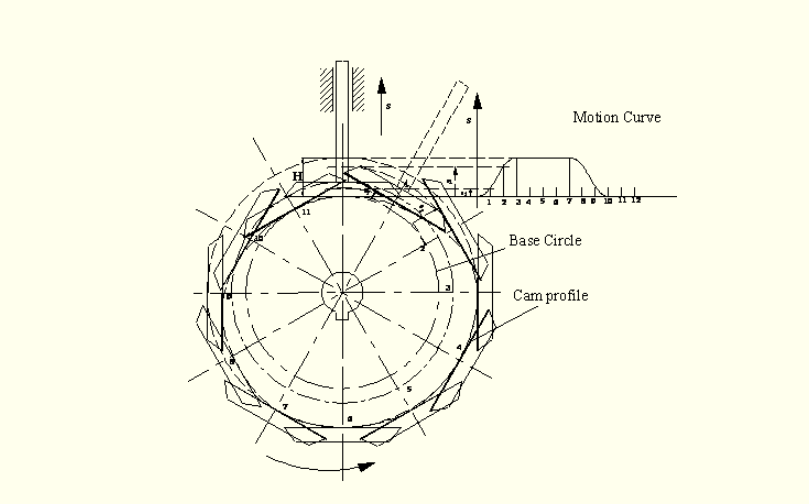
Profile selection in synchronization movements can vary depending on the target machine speed and specific technical motion requirements.
In this article, I will compare commonly used motion profiles and demonstrate their differences through a custom program.
Linear Motion Curve :
This is the profile that instantly follows the position of the master axis. It is commonly used in industrial applications such as traction or pulling axes.
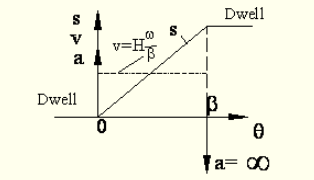
Linear Motion Profile
Cycloidal Motion Curve :
Among all commonly used motion profiles, the cycloidal motion curve has the best dynamic characteristics. The acceleration is finite at all times, and the acceleration at the start and end is zero. It yields a cam mechanism with the lowest vibration, stress, noise, and shock characteristics. Hence, this motion curve is recommended for high-speed applications. It is commonly used in industrial systems where the axis needs to move at high speed.
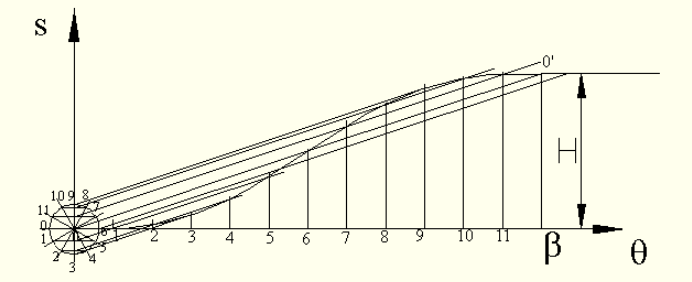
Cycloidal Motion Profile - 1
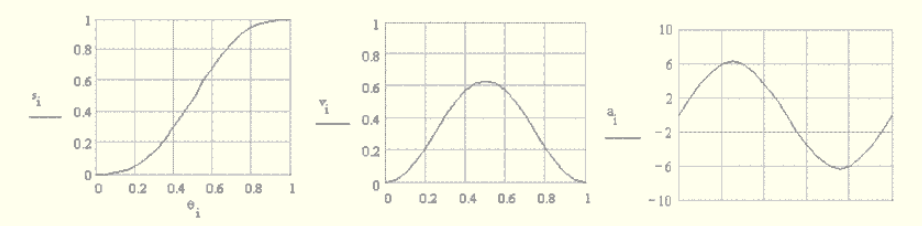
Cycloidal Motion Profile - 2
Double Harmonic Motion Curve :
The curve is composed as the difference of two harmonics. It is an unsymmetrical curve. The rate of change of acceleration at the start of the rise period is small. It is used in industrial systems such as screw filling or D-R-R mechanisms.
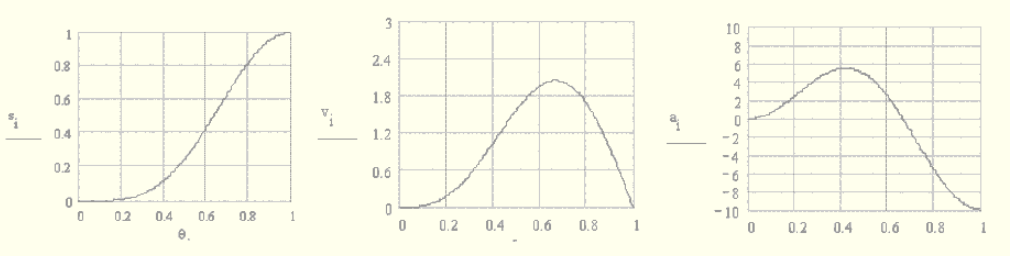
Double Harmonic Profile
Simple Harmonic Motion Curve :
Due to its easy design and smooth continuous motion, the simple harmonic motion is frequently used in low or medium-speed cams. The cam rise section, whose diameter equals the total displacement stroke, is divided according to the cam rise angle. Each point taken on the semicircle is projected vertically, assuming that the cam rotates by a determined interval during this projection. It is used in simple industrial movements that do not require high dynamic performance.
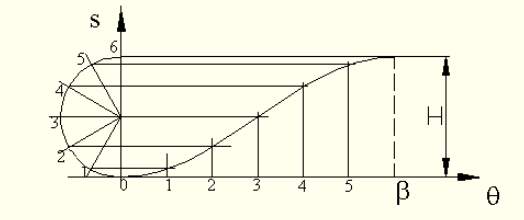
Simple Harmonic Profile - 1
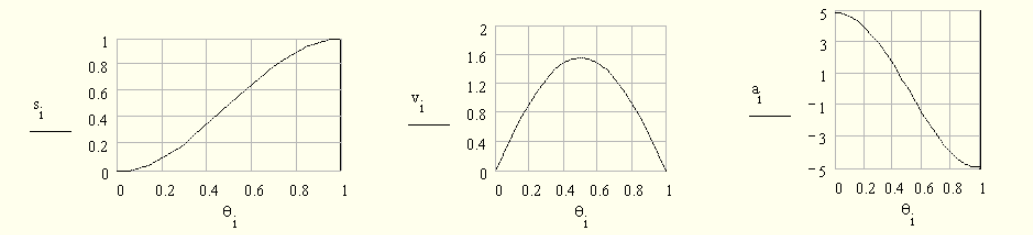
Simple Harmonic Profile - 2
Parabolic Motion Curve :
In parabolic motion, the follower is accelerated with a constant acceleration during the first half of the motion and decelerated with a constant negative acceleration during the second half. It is used in simple industrial applications that do not require high dynamic characteristics.
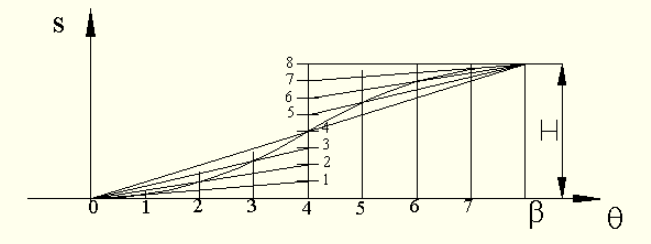
Parabolic Profile - 1
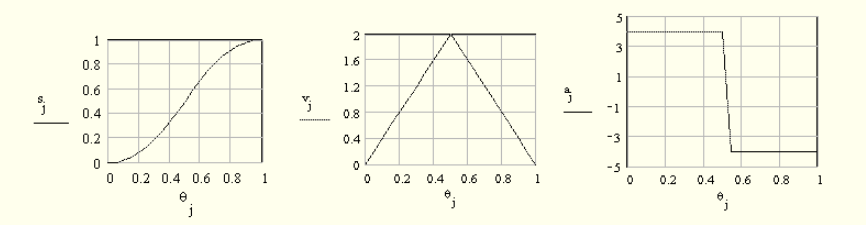
Parabolic Profile - 2
Polynomial 3-4-5 Motion Curve :
The basic motion curves commonly used in practice are generally the ones explained above. However, for high-speed and special applications, different motion curves can be used. In these curves, continuity up to the fourth derivative is required. Motion curves composed of multiple harmonics have been found unsuitable in terms of vibration. Another approach is to use various orders of polynomials as motion curves. It is used in industrial applications that do not require high dynamic properties.
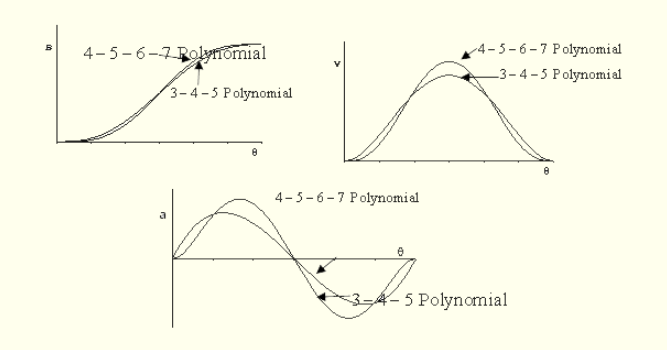
Polynomial 3-4-5 Profile
Cubic Motion Curve :
Cubic curve is the combination of two third order curves. There is no abrupt change at the start or the end of the cycle, but there is an infinite slope on the acceleration curve at the midpoint of the cycle, which is not advantageous. The curve is not very practical. There are no specific industrial applications for this curve, and it is not a recommended type.
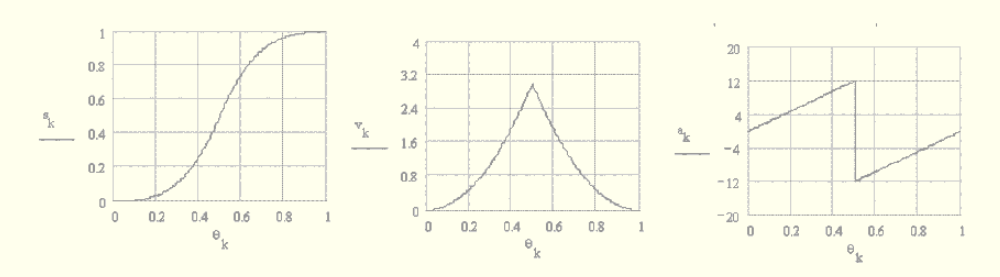
Cubic Profile
General Comparison of Motion Profiles :
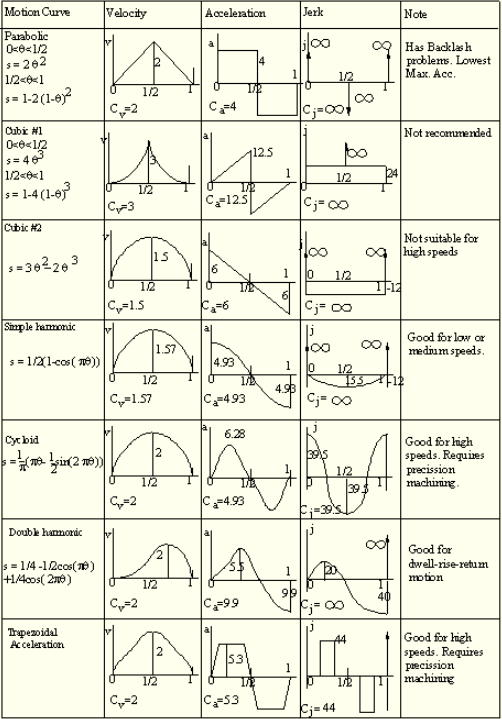
Comparison Motion Profiles
In the video below, I rotated a master axis and moved all curves to the same target point. For visualization, I used C++ and SDL3 technologies.
Article Video
Reference
Middle East Technical University OpenCourseWare
ocw.metu.edu.tr
CAM Mechanisms Article
Professor Dr. Eres Söylemez - Department of Mechanical Engineering